When Should You Take Your Child to the ER for Fever? (Age-by-Age Emergency Guide)
A comprehensive guide to when pediatric fever requires an ER visit. Covering newborn fever, febrile seizure management, and danger signs, based on AAP guidelines and ER experience.
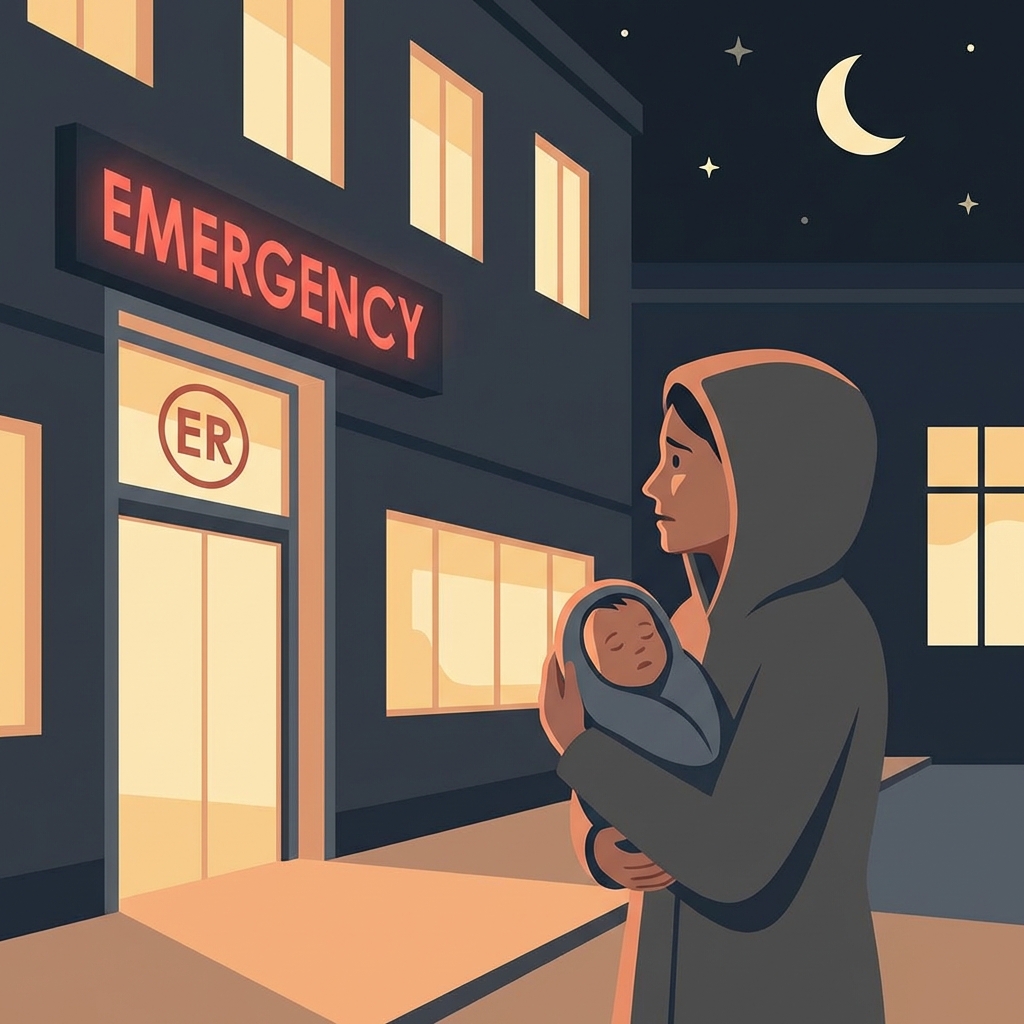
The Scene at the ER at 2 AM
During my ER rotations, parents would inevitably come rushing in with their child around 2 or 3 in the morning. Most of them said the same thing:
"The fever won't come down. Is it something serious?"
Their eyes were filled with fear. The numbers 39 and 40 on the thermometer had amplified their anxiety to the extreme. But when I examined the children, they generally fell into two groups.
On one side, a child whose fever was nearly 104°F (40°C), but who was sitting in the exam room fidgeting with toys, eyes full of curiosity. On the other, a child at just 100.4°F (38°C), limp and barely able to open their eyes. What truly determined whether a case was an emergency was not the temperature number, but the child's overall condition.
I fully understand the anxiety parents feel. But knowing the criteria for a true emergency in advance can free you from unnecessary fear, and help you respond faster when a genuinely dangerous moment arises.
That said, even I was no different the night Yunseul first spiked a high fever. She was about 10 months old and had roseola with a fever over 104°F (40°C). In my head, I knew "her vitals are fine, just observe," but my hand was already reaching for the car keys. In front of your own child, even a doctor is just a parent. After that night, I began telling parents with even more sincerity: "Know the criteria ahead of time."
Age-by-Age ER Visit Criteria
The same temperature can have entirely different implications depending on the child's age. Younger infants, in particular, have immature immune systems and face a higher risk of serious bacterial infection.
Why Newborns (0-28 Days) Are at the Highest Risk
There is a clear reason newborn fever is placed at the very top.
Babies within 28 days of birth have extremely immature immune systems. While they have some antibodies received from their mother, their ability to independently fight infection is very limited. When a fever of 100.4°F (38°C) or higher is confirmed at this age, the chance of an invasive bacterial infection (IBI) is approximately 3-5%. This is a rate that absolutely cannot be ignored.
Sepsis, bacterial meningitis, and urinary tract infections could be the cause, and it is difficult to distinguish these from a simple viral infection based on symptoms alone in the early stages. That is why, for newborn fever, even if the temperature is just over 100.4°F (38°C) and the baby appears fine, you must go to the ER immediately.
Key point: For babies under 3 months, fever is not something you can "wait and see" about. For newborns within 28 days, a temperature of 100.4°F (38°C) or above means an ER visit, no exceptions.
1-3 Months
At this age, the immune system is still not fully developed. If the temperature reaches 100.4°F (38°C) or higher, seek medical care immediately to rule out serious bacterial infections such as sepsis, meningitis, or urinary tract infection. If the pediatrician's office is closed, the ER is the right place to go.
3-6 Months
Starting at this age, the immune system begins to mature gradually. If the temperature reaches 100.9°F (38.3°C) or higher, a pediatric office visit is recommended to rule out bacterial infection. If it is not the middle of the night, a next-day appointment may be acceptable, but if the child looks unwell, seek care right away.
6 Months and Older
From 6 months onward, the immune system is reasonably developed, so the child's overall condition becomes a more important factor than the fever itself. However, if a high fever of 104.9°F (40.5°C) or above does not respond to fever medicine and the child is lethargic or deteriorating, an ER visit should be considered.
Regardless of Temperature, Go to the ER for These Symptoms
Whether the temperature is 100.4°F (38°C) or 102.2°F (39°C), if any of the following symptoms are present, go to the ER immediately. These warning signs are far more important than the number on the thermometer.
Neurological Warning Signs
- Altered consciousness: Unusually dazed, slow to respond, or unable to make eye contact
- Extreme lethargy: Falls right back asleep when woken, or cannot be woken at all
- Inconsolable crying: Nothing helps -- holding, feeding, soothing -- crying continues for 30 minutes or more
- Neck stiffness: Difficulty bending the head forward (suspected meningitis)
Respiratory Warning Signs
- Difficulty breathing: Visible pulling in of the skin between the ribs or below the breastbone with each breath (chest retractions)
- Rapid breathing: Noticeably faster breathing than usual
- Blue lips or nails (cyanosis): A sign of insufficient oxygen
- Grunting sounds: A moaning-like sound with each breath
Dehydration Warning Signs
- Crying without tears: The child cries but no tears are produced
- No urine for 8+ hours: Diaper stays dry
- Dry, cracked lips and tongue
- Sunken-appearing eyes
- Sunken fontanelle (soft spot) (in infants)
Skin Warning Signs
- Petechiae: Small purple or red spots on the skin that do not fade when pressed. (If spots remain visible when pressed through a clear glass, go to the ER immediately)
- Rapidly spreading rash: A rash that spreads noticeably within hours
- Mottled or pale skin
Trust your parental instinct: Even if your child's symptoms are not on this list, if you have the feeling that "something is definitely off," that alone is a sufficient reason to seek medical care.
Febrile Seizures: How to Respond
Febrile seizures are among the most terrifying experiences a parent can go through. When a child suddenly stiffens, their eyes roll back, and their arms and legs shake, anyone would panic.
What Is a Febrile Seizure?
A febrile seizure is a seizure that occurs in children between 6 months and 5 years of age, associated with fever. Approximately 2-5% of all children experience febrile seizures (Western data; the rate may be higher in Asian populations). They most commonly occur when fever is rising rapidly. There is a genetic predisposition -- if a parent had febrile seizures, their child has a higher chance of experiencing them too.
An important fact: Most febrile seizures stop on their own within 5 minutes.
What to Do and What NOT to Do During a Seizure
| DO | DO NOT |
|---|---|
| Lay the child on their side (to protect the airway if they vomit) | Do NOT put anything in the mouth (no spoons, no fingers) |
| Move nearby hazards away | Do NOT restrain or hold the child down |
| Note the time the seizure starts | Do NOT try to give water or medicine during the seizure |
| Call 911 immediately if it lasts more than 5 minutes | Do NOT shake the child in panic |
| If possible, record a video of the seizure | Do NOT pour cold water on them or try to force them awake |
The 5-Minute Rule: If a seizure lasts more than 5 minutes, call 911 immediately. Seizures lasting over 5 minutes risk progressing to status epilepticus, which requires emergency medication.
Simple vs. Complex Febrile Seizures
A simple febrile seizure is generalized (affecting the whole body), lasts less than 15 minutes, and does not recur within 24 hours. The prognosis in these cases is very good.
If any of the following apply, it is classified as a complex febrile seizure, and the child must be evaluated in the ER:
- Seizure lasting 15 minutes or longer
- Seizure affecting only one side of the body (focal seizure)
- Two or more seizures within 24 hours
A Critical Fact to Know
Simple febrile seizures do not cause brain damage. This has been confirmed by decades of research. Children who experience febrile seizures show no differences in intellectual development, academic achievement, or behavioral development compared to those who have not.
However, a first-time febrile seizure, even if it is brief, must be evaluated by a medical professional. This is necessary to rule out the possibility of seizures caused by other conditions, such as meningitis or encephalitis.
Fever Phobia: Let Go of Unnecessary Fear
"Fever phobia" is a term first used by Dr. Barton Schmitt in 1980 to describe parents' excessive and irrational fear of fever. Decades later, this phenomenon persists.
Misconception: "A High Fever Will Damage the Brain"
Fact: Fever from infection is a controlled response regulated by the hypothalamus in the brain. Under this mechanism, it is extremely rare for body temperature to rise above 107.6°F (42°C). Brain damage can only occur above 107.6°F (42°C), and this level is only reached in situations like heatstroke, where the body's temperature regulation itself has shut down. Fever caused by typical infections rarely exceeds 105.1°F (40.6°C).
Misconception: "If the Fever Won't Go Down, It Must Be a Serious Illness"
Fact: The degree of response to fever medicine alone cannot determine the severity of an infection. Viral infections such as influenza and adenovirus can cause fevers above 104°F (40°C) with a slow response to antipyretics. Conversely, some serious bacterial infections may only cause a low-grade fever. What matters is the child's overall condition, not the temperature number.
An Unnecessary Habit: Waking a Sleeping Child to Give Medicine
Studies show that 85% of parents wake a sleeping child to give fever medicine, and 25% of parents administer fever medicine even below 100°F (37.8°C).
But there is no need to wake a child who is sleeping comfortably. Sleep itself is the best recovery process, and the purpose of fever medicine is not to restore a normal temperature but to relieve the child's discomfort. If there is no discomfort and the child is sleeping well, the treatment goal has already been achieved.
Summary: When to Go to the ER vs. When You Can Observe at Home
| Go to the ER | Can Observe at Home |
|---|---|
| Any baby under 3 months with 100.4°F (38°C) or higher | Child over 6 months with 102.2°F (39°C) who is playing and eating well |
| Altered consciousness, limpness, inconsolable | Child regains energy after fever medicine |
| Seizure lasting more than 5 minutes | Child is sleeping comfortably despite fever |
| Difficulty breathing, blue lips | Fluid intake is adequate |
| Petechial rash | Urine output is normal |
| Neck stiffness (nuchal rigidity) | Child fusses but calms when held |
During my ER days, many parents would come in the early hours and leave saying, "Thank goodness it wasn't anything serious." Each time, I would tell them, "Coming in was absolutely the right call."
When in doubt, it is always better to come in. But knowing these criteria means that when your child's forehead feels hot in the middle of the night, you can first take a calm look at their overall condition before reaching for the car keys.
References
- American Academy of Pediatrics (AAP) - Clinical Practice Guideline: Evaluation and Management of Well-Appearing Febrile Infants 8 to 60 Days Old (Pediatrics, 2021)
- American Academy of Pediatrics (AAP) - Fever and Antipyretic Use in Children (2011, reaffirmed 2018)
- Korean Pediatric Society - Guidelines for Fever Management in Children
- Mayo Clinic - Febrile Seizures
- JAMA Pediatrics - Fever phobia revisited: Have parental misconceptions about fever changed in 20 years?
Medical Disclaimer: This article is for general informational purposes only and does not replace clinical judgment in an emergency. If you are worried about your child's condition, do not hesitate to visit a medical facility, even if your situation does not fit the criteria listed here. A parent's instinct is sometimes more accurate than a thermometer.
Read More
- When to Give Fever Medicine? - Even at 102.2°F (39°C), if your child is playing well, you can watch and wait
- Why Ice Packs and Tepid Sponging Can Be Harmful - Medical evidence summary
- Fever Medicine Calculator by Doctor Dad - Calculate accurate dosages instantly
Frequently Asked Questions
Should I take my child to the ER for a 104°F (40°C) fever?▼
What should I do if my child has a febrile seizure?▼
Should I go to the ER if fever lasts more than 3 days?▼
⚠️ Medical Disclaimer: This article is for general informational purposes only and does not replace medical advice. Always consult your child's doctor for health decisions.