Ibuprofen vs Tylenol: What's the Difference? (Doctor's Guide to Choosing Fever Medicine)
A comprehensive comparison of ibuprofen (Motrin/Advil) and acetaminophen (Tylenol). Covering mechanism of action, duration, side effects, and age restrictions based on AAP guidelines.
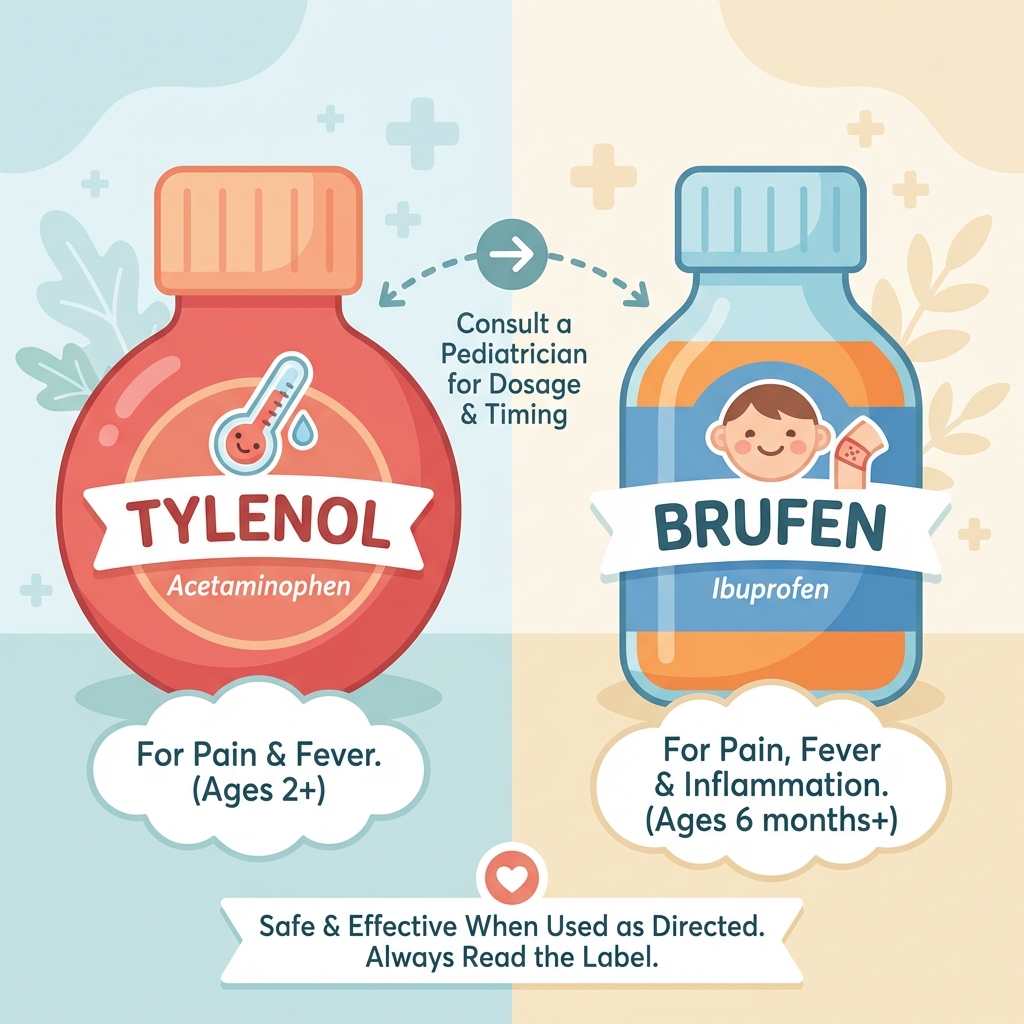
The Question at the Pharmacy
Not long ago, I got a call from daycare saying Yunseul had a fever. After rushing out of work, I stopped by the pharmacy, where I saw a father standing at the counter, looking uncertain.
"Tylenol or ibuprofen?"
The pharmacist's question caught him off guard. "Uh... aren't they both fever reducers? Doesn't it matter which one?"
The scene felt familiar. One of the most common questions parents ask in the ER is, "Which is better, Tylenol or ibuprofen?"
The answer is that it is not about finding the "better" medicine but about choosing the one that fits the situation. The two drugs differ in their ingredients, how they work, and what to watch out for. Let me break down the differences clearly.
Key Comparison Table
Let's start with what matters most.
| Category | Tylenol (Acetaminophen) | Ibuprofen (Motrin/Advil) |
|---|---|---|
| Drug class | Non-opioid analgesic/antipyretic | Nonsteroidal anti-inflammatory drug (NSAID) |
| Mechanism | Antipyretic and analgesic via central nervous system | Systemic anti-inflammatory + antipyretic + analgesic |
| Anti-inflammatory effect | None | Yes |
| Onset of action | 30-60 minutes | About 30 minutes |
| Duration | 4-6 hours | 6-8 hours |
| Dosing interval | At least 4 hours | At least 6 hours |
| Maximum daily doses | 5 times | 4 times |
| Minimum age | 4 months | 6 months |
| Dose per weight | 10-15 mg/kg | 5-10 mg/kg |
| Concentration (syrup) | 32 mg/mL (100mL bottle), 50 mg/mL (200mL bottle) | 20 mg/mL |
| Main side effects | Liver toxicity (overdose) | GI upset, kidney effects |
Remembering just this table can save you from feeling lost at the pharmacy.
Mechanism of Action: What Makes Them Different?
They are both called "fever reducers," but they work in fundamentally different ways inside the body.
Tylenol (Acetaminophen)
Acetaminophen acts on the pain and temperature regulation centers in the brain to lower fever and reduce pain. Its exact mechanism is not fully understood, but it is thought to primarily work by inhibiting COX (cyclooxygenase) enzymes in the central nervous system.
The key point is that it has no anti-inflammatory effect. Because it acts only in the brain, it does not affect inflammation throughout the body.
Ibuprofen (Motrin/Advil)
Ibuprofen is an NSAID (nonsteroidal anti-inflammatory drug) that inhibits prostaglandin synthesis throughout the body. Since prostaglandins mediate inflammation, pain, and fever, ibuprofen reduces all three: inflammation, pain, and fever.
Why Does This Matter in Practice?
For conditions involving inflammation, such as ear infections or pharyngitis, ibuprofen may offer better pain relief due to its anti-inflammatory properties. For simple fever or mild pain, acetaminophen is often sufficient.
Efficacy Comparison: Which One Works Better?
This is what parents want to know most.
A 2024 network meta-analysis published by the AAP (American Academy of Pediatrics) analyzed 31 randomized controlled trials involving 5,009 children.
The findings:
- Ibuprofen showed superior fever reduction compared to acetaminophen at 2, 4, and 6 hours after administration
- At the 4-hour mark, the ibuprofen group showed temperatures that were on average 0.38°C (0.68°F) lower
- However, whether this difference is clinically meaningful remains debated
"Both are safe and effective" is the AAP's official position. Neither is overwhelmingly superior to the other.
A difference of 0.38°C (0.68°F) might seem significant, but remember that what matters most is the child's overall condition, not the temperature reading itself.
Side Effects: What to Watch Out For?
Both medications are safe at appropriate doses, but they carry different risks.
Tylenol (Acetaminophen) Precautions
- Risk of liver damage with overdose: Do not exceed the daily maximum of 75 mg/kg/day
- Watch for duplicate dosing: Many cold medicines and combination syrups already contain acetaminophen. Giving Tylenol on top of these without realizing it can lead to overdose
- At appropriate doses, it is gentle on the stomach and a very safe medication
Ibuprofen Precautions
- GI irritation: Can cause stomach upset when taken on an empty stomach. Always give with food or milk
- Kidney stress during dehydration: If a child is dehydrated from vomiting or diarrhea, ibuprofen can put extra strain on the kidneys
- Contraindicated during chickenpox: There are reports of increased risk of necrotizing fasciitis during chickenpox, so ibuprofen should be avoided
- For children who are dehydrated from vomiting or diarrhea, acetaminophen is the safer choice
Situation-Based Selection Guide
Here is a practical guide for answering "So which one should I give my child?"
| Situation | Recommended | Reason |
|---|---|---|
| 4-6 months old | Tylenol | Ibuprofen cannot be used under 6 months |
| Vomiting/dehydration present | Tylenol | Less burden on stomach and kidneys |
| Ear infection, pharyngitis, or other inflammation | Ibuprofen | Anti-inflammatory effect helps with pain relief |
| Long-lasting fever | Ibuprofen | 6-8 hour duration is advantageous for nighttime management |
| Post-vaccination fever | Tylenol | Generally the first-line choice |
| Chickenpox or chickenpox exposure | Tylenol only | Ibuprofen is contraindicated due to risk of necrotizing fasciitis |
When Yunseul came home from daycare with a fever along with an ear infection, I gave her ibuprofen. When she had a mild fever after vaccinations, I used Tylenol. The choice varies by situation.
Absolutely Forbidden Combinations
The most dangerous mistake when choosing a fever reducer is giving two medications from the same drug class.
- Ibuprofen + Dexibuprofen: Both are NSAIDs (ibuprofen + dexibuprofen). Combining drugs from the same class dramatically increases the risk of GI bleeding and kidney damage
- Tylenol + Champ (red label): Both contain acetaminophen. Duplicate dosing increases the risk of liver damage
- Tylenol + Ibuprofen alternating: These are from different drug classes, so alternating is possible after consulting a doctor. However, it is not routinely recommended
Just because the brand names are different does not mean the ingredients are different. Always check the active ingredient (acetaminophen/ibuprofen/dexibuprofen).
Summary
- Tylenol and ibuprofen have different mechanisms of action -- Tylenol provides central antipyretic and analgesic effects, while ibuprofen provides systemic anti-inflammatory, antipyretic, and analgesic effects
- Ibuprofen shows slightly better fever reduction, but the AAP's official position is that both are safe and effective
- Under 6 months, only Tylenol is an option -- ibuprofen can only be used from 6 months onward
- Use Tylenol for dehydration or vomiting, ibuprofen when inflammation is present
- Never duplicate medications from the same class -- check the active ingredient, not just the brand name
- Accurate dosing matters -- use the weight-based dosage calculator for precise calculations
References
- American Academy of Pediatrics (AAP) - Short-term Dual Therapy or Mono Therapy With Acetaminophen and Ibuprofen for Fever (Pediatrics, 2024)
- JAMA Pediatrics - Efficacy and Safety of Acetaminophen vs Ibuprofen for Treating Children's Pain or Fever
- MFDS (Ministry of Food and Drug Safety) - Children's Ibuprofen Syrup and Children's Tylenol Suspension prescribing information
- Korean Pediatric Society - Guidelines for Fever Management in Children
Medical Disclaimer: This article is for general informational purposes only and the appropriate medication may differ depending on your child's individual condition. If your child has an underlying medical condition or drug allergy, always consult with a doctor.
Read More
- Tylenol Dosage by Weight - Quick reference for 5 kg to 30 kg
- Can You Alternate Tylenol and Ibuprofen? - Safe usage based on AAP guidelines
- When to Give Fever Medicine? - Don't obsess over the thermometer number
Frequently Asked Questions
Is ibuprofen or acetaminophen more effective for children's fever?▼
At what age can babies take ibuprofen?▼
Can ibuprofen be given during chickenpox?▼
⚠️ Medical Disclaimer: This article is for general informational purposes only and does not replace medical advice. Always consult your child's doctor for health decisions.